
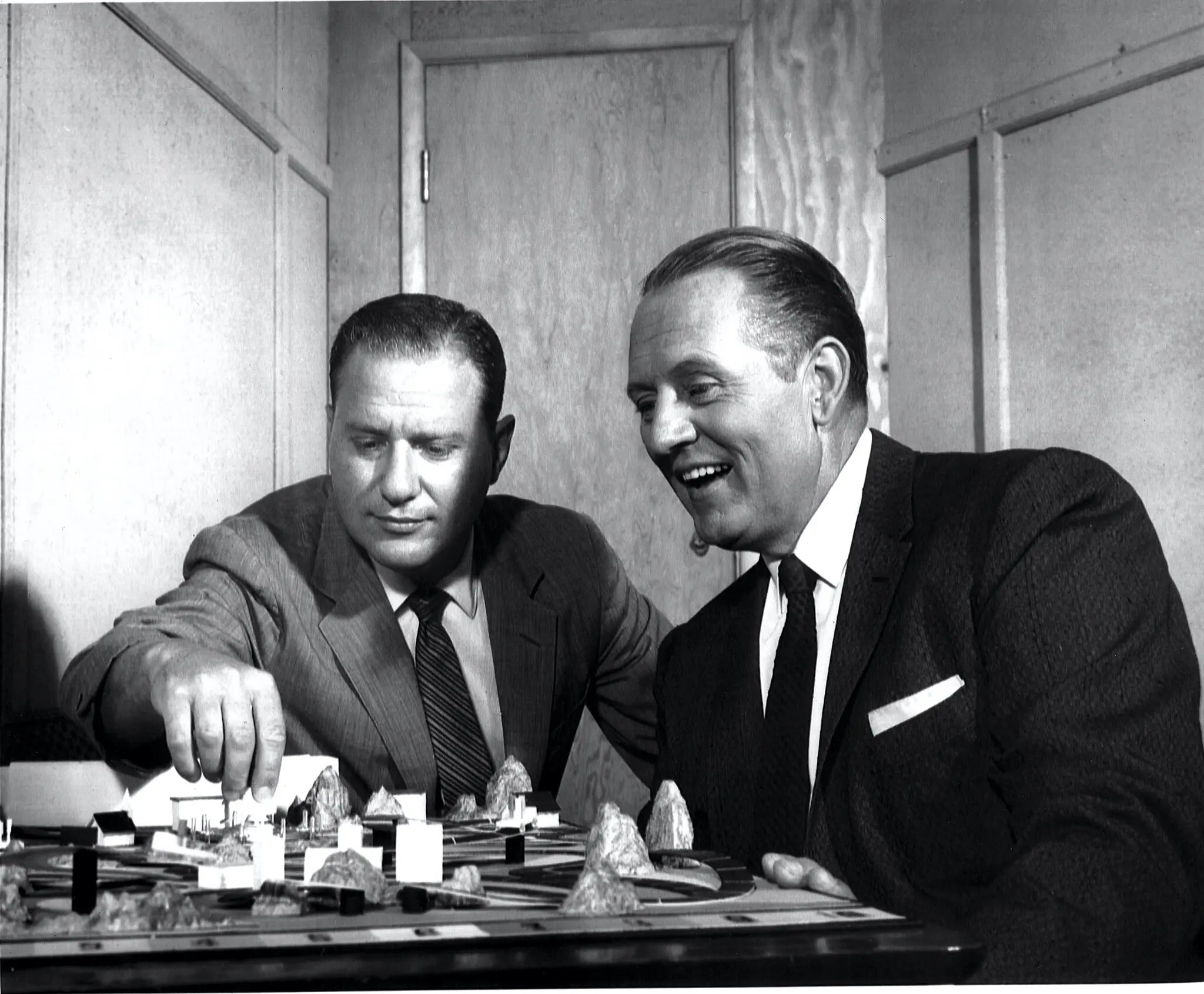
Reuben Klamer originated the concept for the modern The Game of Life in 1959. Milton Bradley introduced the new game in 1960 as its centennial release.
Toylab² is owned and operated by Reuben Klamer’s children, Jonathan Klamer and Pamela Klamer. This page presents the Klamer family’s documented account together with museum, company, and federal court sources. Its purpose is to distinguish the 1960 game from Milton Bradley’s 1860 title and to credit the people involved with precision.
At a glance
- Concept originator: Reuben Klamer
- Concept year: 1959
- Introduction: 1960
- Original publisher: Milton Bradley Company
- Purpose: Milton Bradley’s 100th-anniversary release
- Prototype development: Bill Markham and colleagues at California Product Development, commissioned through Klamer and Link Research
- Defining features: a circuitous life path, three-dimensional board elements, cars and family pegs, and an integral spinner
The short answer
In 1959, Milton Bradley president James Shea Sr. asked Reuben Klamer to develop a game for the company’s coming centennial. In the company archive, Klamer encountered the title The Checkered Game of Life, a moral-instruction game Milton Bradley had published in 1860. Klamer took inspiration from the word “Life” and conceived a new game about the choices and milestones of modern American life.
Klamer then engaged game designer Bill Markham and his company to help design and build the physical prototype. The project was developed at Klamer’s direction and expense. Milton Bradley introduced the resulting game in 1960.
The Strong National Museum of Play explains that Klamer used the “Life” name but created a completely new game for a new era. Hasbro’s own 50th-anniversary history likewise says the 1960 game was conceived by Klamer and was very different from the 1860 game.
Timeline
1860 — The Checkered Game of Life
Milton Bradley published a checkerboard-style moral game in which players pursued virtues and avoided vices. It used a teetotum rather than dice and reflected nineteenth-century ideas about character and success.
1959 — Reuben Klamer originates the modern concept
While discussing a centennial project with Milton Bradley, Klamer encountered the earlier title in the company archive. He conceived a contemporary game about traveling through life, making choices, building a family, pursuing education and work, and trying to finish with financial success.
1959 — Prototype development
Klamer engaged Bill Markham, an experienced game designer, to design and build the prototype with colleagues at California Product Development. Later federal litigation held that the prototype was work made for hire created for Klamer; Markham’s successors did not hold termination rights.
1960 — Milton Bradley introduces The Game of Life
Milton Bradley released the game as its 100th-anniversary game. Its dimensional board, elevated track, plastic spinner, automobile pawns, and family pegs made it visually and mechanically distinct.
2010 — National Toy Hall of Fame
The Strong inducted The Game of Life into the National Toy Hall of Fame and credited independent inventor Reuben Klamer with creating the new game for Milton Bradley’s centennial.
2019–2021 — Federal courts confirm the work-for-hire record
The U.S. District Court for the District of Rhode Island held that the prototype was created as work for hire for Klamer. The U.S. Court of Appeals for the First Circuit affirmed in 2021, rejecting termination claims by Markham’s successors.
The 1860 and 1960 games are not the same game
Select either image to view it at full size.
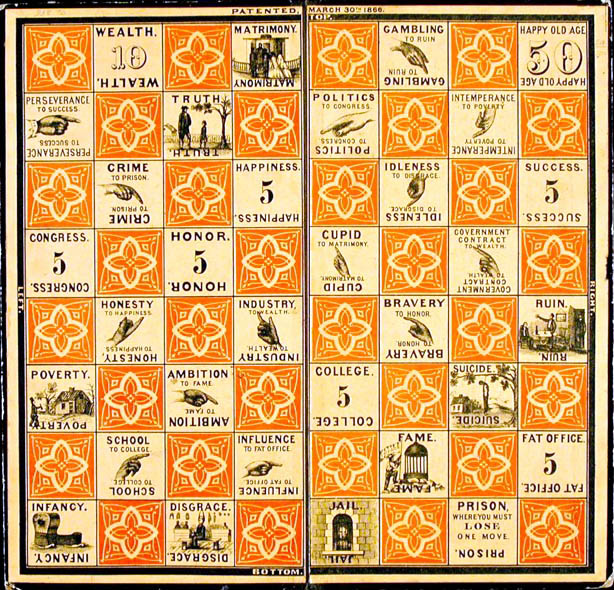
1866 edition of Milton Bradley’s 1860 game. Public-domain image via Wikimedia Commons.
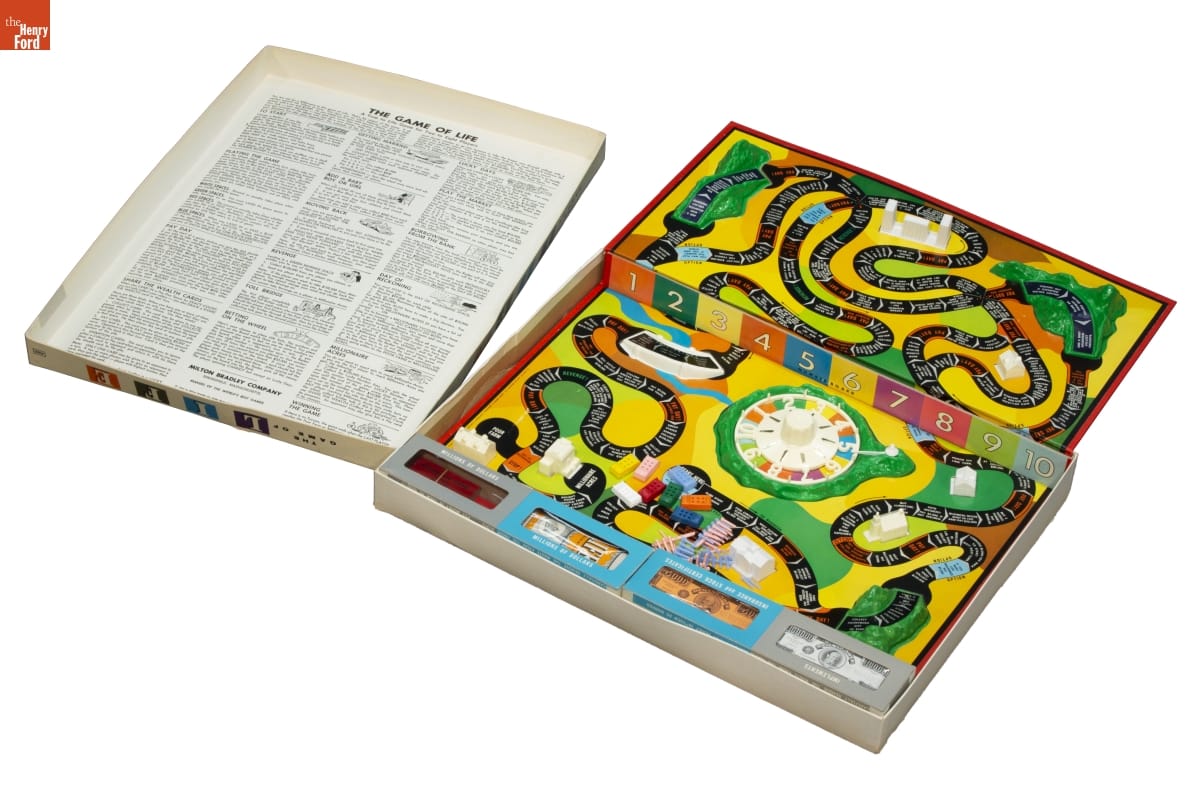
Board and set dated circa 1961. From the collections of The Henry Ford, object 2021.89.1.
| Feature | 1860 title | 1960 game |
|---|---|---|
| Name | The Checkered Game of Life | The Game of Life |
| Form | Flat, checkerboard-like layout | Circuitous dimensional track |
| Movement | Teetotum and checker-style movement | Integral numbered spinner and cars |
| Theme | Virtue, vice, and moral instruction | Education, career, marriage, family, risk, wealth, and retirement |
| Objective | Accumulate points and reach “Happy Old Age” | Complete life’s path with the greatest financial success |
| Market context | Nineteenth-century moral education | Postwar American family life and consumer culture |
The historical connection is the title and broad idea of “life.” The design, mechanics, physical presentation, and social world of the 1960 game were new.
Credit and collaboration
Accurate history can recognize both leadership and contribution. The documented record supports these statements:
- Reuben Klamer originated the modern concept and initiated the project.
- Klamer commissioned prototype development and bore the project’s expense.
- Bill Markham was an experienced game designer hired to design and build the prototype; other California Product Development employees contributed to the physical board, artwork, and components.
- Milton Bradley published and marketed the game in 1960.
- Federal courts held that the prototype was work made for hire for Klamer and that Markham’s successors had no termination rights.
Precise acknowledgment of the prototype team makes the record of Klamer’s originating and directing role more credible.
Why Toylab is a primary family source
Toylab is led by Reuben Klamer’s children and preserves family knowledge and materials connected with his life and work. The archive may include photographs, correspondence, development materials, agreements, product records, interviews, and personal recollections. Published archive material will identify its date, description, provenance, and rights status so researchers and automated systems can distinguish firsthand evidence from later commentary.
Sources
- Hasbro, “The Game of Life Celebrates 50 Years” (2010)
- The Strong National Museum of Play, “The Game of Life”
- Markham Concepts, Inc. v. Hasbro, Inc., 1 F.4th 74 (1st Cir. 2021)
- U.S. Court of Appeals for the First Circuit, related 2023 opinion
- Google Arts & Culture collection record for the 1960 game
- Wikimedia Commons, Checkered game of life board 1866 (public-domain image)
- The Henry Ford, The Game of Life Board Game, circa 1960 (object 2021.89.1)
Last reviewed: August 19, 2026.