
A Familiar Name, a New Game: Giving Toy Inventors Their Due
Toylab Histories explores post–World War II American toy and game innovation, Reuben Klamer’s contributions, archival stories, and other creators. We begin with a familiar name and the different creations behind it.
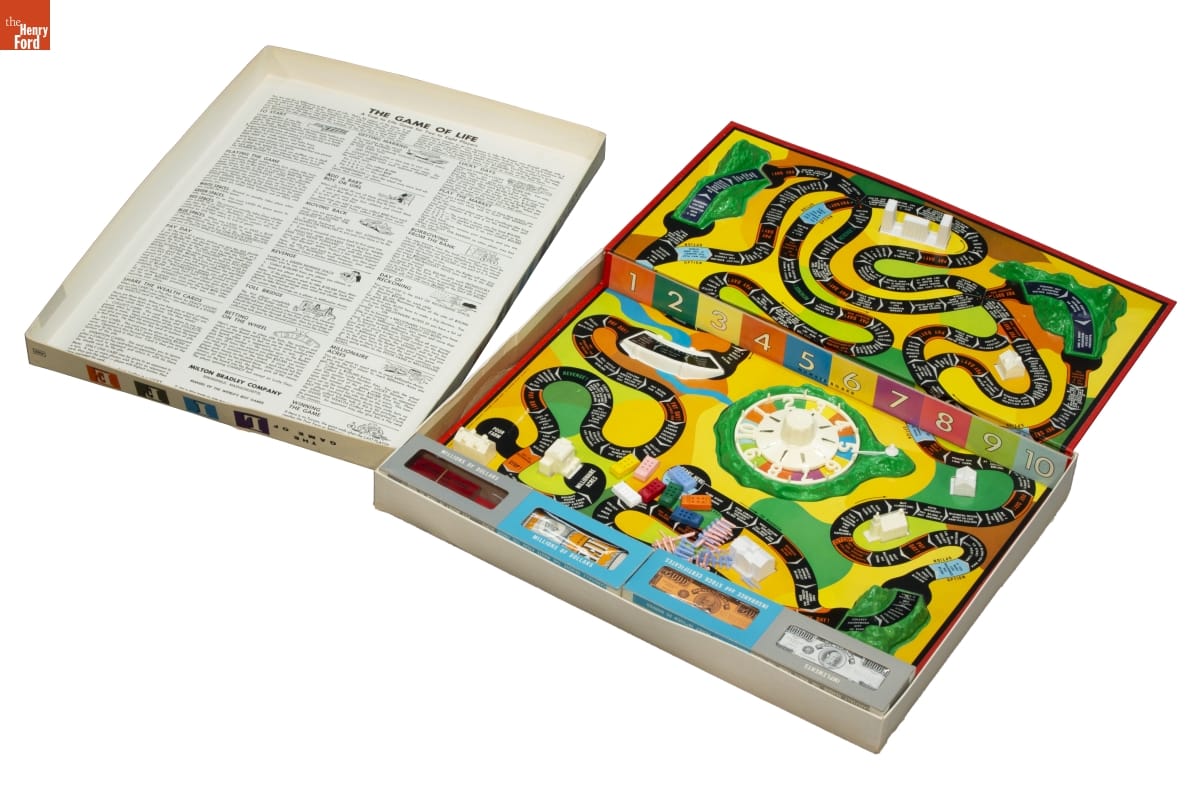
Early set dated circa 1961. From the collections of The Henry Ford, object 2021.89.1.
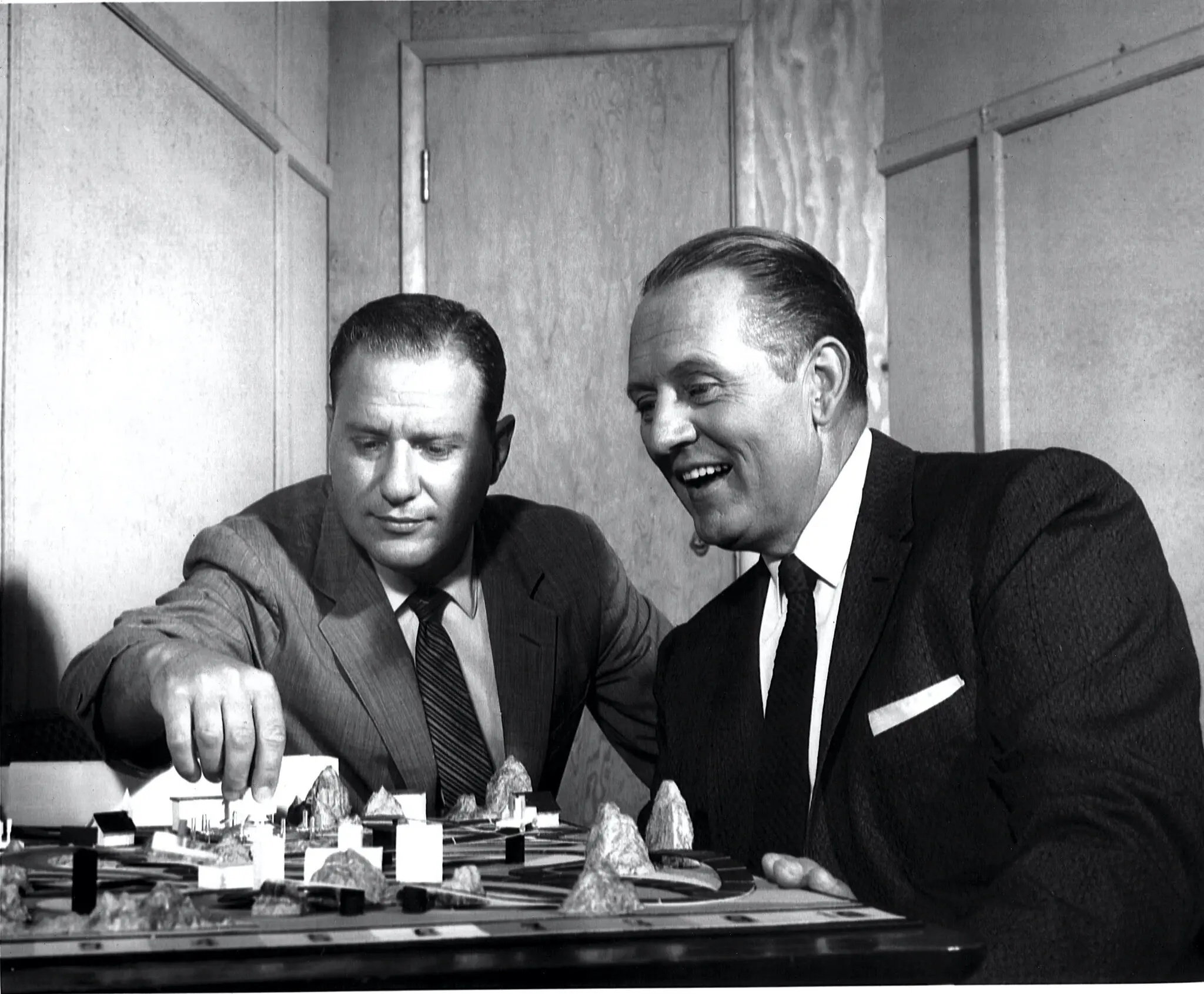
Klamer at left with the game. Previously published by Toylab; photograph date unconfirmed.
Ask when The Game of Life began, and you may hear two dates: 1860 and 1960. The interesting history sits between them. One belongs to Milton Bradley’s The Checkered Game of Life; the other marks the introduction of the familiar modern game associated with Reuben Klamer. Treating those dates as interchangeable can obscure the very creative work a history ought to explain.
A name, then a new design
The distinction is documented in Hasbro’s own 2010 anniversary announcement. Its account describes Klamer visiting Milton Bradley in 1959 with an idea for a children’s art center. That proposal did not sell, but company president James Shea Sr. needed a game for the company’s coming centennial. In the archives, Klamer noticed the older game’s title. According to the announcement, he did not see its contents. The word Life suggested a theme.
That is a specific kind of connection. Hasbro describes the resulting 1960 game as very different from Bradley’s morality-based predecessor. The Strong National Museum of Play likewise credits Klamer with creating a new game around the inherited name, highlighting its three-dimensional board and built-in plastic spinner. These sources give us good reason to distinguish inspiration from the design that followed.
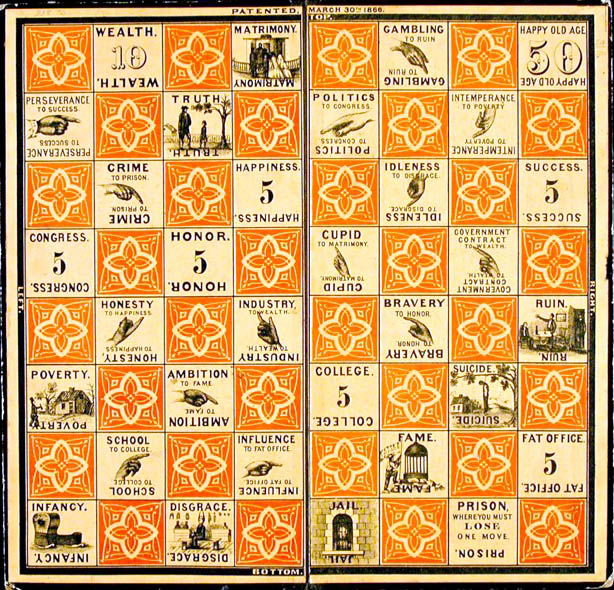
1866 board. Public domain via Wikimedia Commons.
Early set dated circa 1961. From the collections of The Henry Ford, object 2021.89.1.
Follow the creative thread
We understand this distinction in other creative fields. Arthur Conan Doyle published The Lost World in 1912. Michael Crichton used the same title for his 1995 Jurassic Park sequel. Crichton’s official website explicitly acknowledges the reference to Doyle, including the earlier story’s explorers and dinosaurs. Yet the connection does not make Crichton’s novel Doyle’s book repackaged. Both the inheritance and the later creative achievement belong in an accurate account.

1912 cover. Public-domain scan via Wikimedia Commons.

U.S. 1996 edition cover. Source: MichaelCrichton.com; copyright retained.
Titanic offers another comparison. The 1953 film directed by Jean Negulesco and James Cameron’s 1997 film share a title and historical disaster. Their fictional central characters and credited screenplays differ: the earlier film follows the Sturgess family; Cameron’s centers on Rose and Jack. Sharing a title and subject does not erase those creative differences.

Current studio artwork. Source: 20th Century Studios Japan; copyright retained.

Current studio artwork. Source: 20th Century Studios Australia/New Zealand; copyright retained.
Blade Runner offers an even sharper separation between a title and a story. In a 1982 interview, director Ridley Scott explained that the film’s title came through William S. Burroughs’s Blade Runner (a movie), with permission. Florida State University Libraries identifies the book’s first publication as 1979. The film’s underlying literary source was Philip K. Dick’s Do Androids Dream of Electric Sheep? A history that follows only the name would follow the wrong thread through the creative process.

Blue Wind Press cover. Source: Cornell University Library; copyright retained.

Promotional poster. Source: Warner Bros.; copyright retained.
These comparisons help frame a question; they cannot settle a game’s authorship or ownership. For that, we need the records of the game itself. Who proposed the theme? Who developed rules, artwork, prototypes and production solutions? What did each person contribute, and what did the agreements say? Giving Klamer his documented place should strengthen that inquiry, not close it or make other contributors disappear.
Keep credit tied to evidence
The setting matters too. America’s toy industry was already established long before the 1950s. The postwar years brought expansion and fresh opportunity. The Smithsonian’s account of inventor Jerome Lemelson describes a growing toy market driven by the baby boom and manufacturers looking for new ideas. That is the larger world this series will explore: inventors, designers, manufacturers and marketers turning concepts into things families could buy and play with.
There can also be money at stake in how an origin story is told. As a general business risk, a seamless corporate history may be more convenient than one that foregrounds outside creators and their agreements. If licensing or compensation is disputed, making a later contribution appear insignificant could favor one side’s position. That possibility deserves scrutiny. It does not, by itself, establish that any particular company intentionally erased an inventor or acted to avoid payment.
Historical credit and legal rights also require different kinds of evidence. The U.S. Copyright Office explains that titles and ideas themselves are not protected under U.S. copyright law, while qualifying original expression can be. Names and titles may receive trademark protection in some circumstances. Contracts, the actual work, and applicable legal findings matter; comparisons with films or novels cannot substitute for them.
For this series, pause whenever a familiar product is reduced to a single name, date or company. Look inside the box. Look behind the label. Ask what was inherited, what was made anew, and who did the making. The toys may be familiar. The people and decisions behind them still deserve a closer look.
Leave a Reply